Pages

Showing posts with label a little left. Show all posts

Monday, 26 September 2011

Confessions of a Canadian studying in the US

The transition to the US must be the easiest, after all, Canada is America's little sister right? So what's been different in this place? Well for one, people are amused by my fascination with how 12-16oz coffee cups are considered "small", how the tax at the end of the bill never really surpasses $2.00 and why I am bitching about paying for medical insurance when "back home, this is free."

The US is ghetto - this is something I knew before, however, now that I am actually living in the ghetto, I can tell you, Canada really has no ghettos. The "ghettoest" place in Canada is sometimes considered a middle-class neighbourhood here. There is no balance between the rich and the poor here, it feels like Central and South America. Take a turn on the wrong block and grab your vest. Take another turn and make sure you don't get hit by one of those giant yuppie strollers.

Other observations? Here are a few from my short time here:
  • The word "caramel" is said strangely here. It's like "curmel", or maybe because I studied in French me pronouncing it "ca-ra-mel" is bizarre.
  • Pronouncing letters like "T" is forbidden and straight up weird. Baltimore becomes "Ballymore"
  • Flyer is written "flier"
  • Just like the Arab countries, spelling here is inconsistent, example: "Centre Street" and once or twice I saw "theatre" as opposed to "theater".
  • If you thought Service Canada was a mess, wait until you go to the social security office.
  • Accents are difficult to decode, example: "d'you stull wan' a sureal?" (do you still want the cereal).
  • I am collecting too many discount cards - it's like every chain has one. And the savings are legit. I saved a lot of money at Safeway and bought more than six things at a big chain pharmacy (Rite Aid) that added up to $25 (unlike Shoppers, where, if you buy two items, you've spent $23, no matter what you bought).
  • The term "going up to the cottage" or even just the word "cottage" is not used here. I was asked what I meant by several people.
  • I have to attend the orientation sessions with international students, yet every international student is curious to know why I sound like an American but am considered an international student.
  • You know that ring engineers wear on their pinky once they graduate in Canada? They should start implementing that here, there's been some very questionable engineers dealing with massive demolition projects (i.e can't answer basic questions or begin to comprehend the meaning of decontaminating soil).
  • Appetizers are totally meals here.
  • Everyday I feel like I'm living a Spike Lee movie. Or just an American movie.
  • Here, people aren't passive aggressive. Except maybe some. Students, mostly.
  • Spotify, Netflix, Pandora, Amazon Prime...I can't keep up with all these things that aren't available, or have limited availability, in Canada!
  • The word "curated" is too loosely used here. It bothers me. Maybe it's just an art school thing.

Sunday, 3 July 2011

Mind the Gap


My apologies dear readers for being a little less bloggy in 2011. I have been busy with stuff (including putting together Issue 02 of Kalimat which I hope you'll check out), preparations and a visit to London.


Five days is not enough to see swinging London, even if those days are jam packed from 7am until 3am. Regardless, I tried to make the most out of it. I was impressed by a lot of different organisations and people including the Arab arts and cultural scene and the activism scene. There's always something going on here so if you're bored, that's strange. Aside from my jam packed days, London was also the first place where I spent close to 1 hour waiting for a table at a restaurant (Tayyab's). It was well worth it.


I also spent a lot of time comparing the London underground tube system to the TTC, because I enjoy comparing transportation systems. The TTC can learn a thing or two or five from London, and so can New York for that matter. Although the Tube is crammed, terribly hot and expensive, it works and for someone who is using it for the first time, it's simple (despite the intimidating map). Maybe I'll save those for another post.


Despite the warnings that London is expensive, when I think about it, if 1 pound sterling is relative to 1 dollar, then it isn't that much different (food, clothing, etc). Other London observations:
  • the beef tastes really weird
  • for a chain that's on (almost) every street corner, Pret a Manger chocolate croissants are delicious,
  • if you're at Russell Square station, consider taking the lift up
  • I have never encountered so many American tourists in my life,
  • every curry house on Brick Lane claims to be the best one in town, some even include the direct link to the BBC article on their sign
  • I have never seen so many Kuwaiti tourists in my life....


  • British internet is slower than North American internet but it's faster than European internet
  • ask for tap water, otherwise, you'll pay 3 pounds for a glass bottle
  • this place is super multicultural
  • when the sun comes out, everyone's out
  • you must really "mind the gap" on the Tube
  • galleries are free...


  • If you cross the street when there is no "walk" sign, you are fair game, like the Arab world, Londoners do not stop. It's more dangerous in London because they drive on the left and most people are not accustomed to this so it adds to their confusion. The city has painted "Look Right" and "Look Left" on the streets at the crossings to make it easier, I think it was due to the tourist death toll from crossing the street related incidents.


Tuesday, 24 May 2011

The yuppie's guide to protests

Having been part of the activist community for many years, I've learned a thing or two about organising protests - on both sides. Here's a handy list that you can use to get started on your next rally.

PS:
This mostly applies to a Palestinian protest with an Israeli opposition on the other side. PPS: This blog post is not attempting to undermine my peoples, I do after all attend them and believe in the cause, I just also think we can change a few things about them to make them more efficient and make a statement.

Palestinian side
  1. A loud woman on a mega phone yelling out the slogans and constantly reminding you of her refugee status: I want to mention that this may just be a Toronto thing because in other protests I've attended across Canada, this wasn't necessarily the case. She yells slogans like "Stop the Killing stop the crime, Israel out of Palestine" and "No Justice no Peace" but she stops, takes a deep breath and likes to tell you a story about where she's from and how she was exiled and all that. Sometimes it feels like the entire Palestinian story happened to this girl (Nakba, Naksa, Black September, Lebanon, Sabra and Shatila, Gaza) so you start wondering.
  2. Someone performing spoken word poetry: If there's one thing I hate, it's spoken word poetry. There are over 800 reasons why I dislike it, which I won't get into, and for some reason there is always someone who wants to perform spoken word poetry at rallies. Unfortunately this is like the worst kind too.
  3. Gaza: If there's one thing that's really bothering me about the conflict right now it's the separation of Gaza from Palestine. I can't help but get angry when I hear "Free Palestine, Free Gaza" as if the two aren't the same place/people. This is wrong and must be corrected and when you tell people they just look at you, shrug their shoulders and continue chanting it. Another thing that's always noticeable at rallies is that they bring someone from Gaza to speak. Usually this person has never been to Gaza, or visited once in 1995 and has some family there that discuss the situation with them but that's about it. Although they are really connected to Gaza it doesn't make them a credible source. In my opinion, if we changed their role from someone speaking about the situation to just someone giving an inspirational speech that would be better.
  4. A previous revolutionary from either the PLO or PFLP to speak: Ahh the glory days! This is a staple event - the man never refers to his past, you just know who he is if you've read some books. He serves as the "motivational speaker" getting the crowd going and excited. Usually the man is a total 3ammo (uncle) wearing a leather jacket, a plaid shirt with a pen in the pocket, probably has a mustache, wears khakis and chain smokes. You relate to him because your dad most likely resembles him. Not mine though.
  5. The Keffiyeh: The dude who only goes to Arab parties to meet girls decides to attend his first protest. His contribution? A keffiyeh. Also, everyone who owns a keffiyeh wears it on a day when a rally is taking place, it's the code.
  6. Someone selling Marxist magazines: Rain or shine, these homies are there selling.
  7. An elderly passing out flyers: Just like the Marxist magazine sales people the old folks are running around the crowd (rain or shine) passing out "flyers". Usually they aren't flyer size but either 8.5x11 or 11x17, typed with comic sans or times new roman and include way too much information. Let's get creative with visual communication materials, as I discussed here.
  8. The backwards flag: No matter where you go, this is a staple item. The flag is backwards. Why? Don't ask me, it just happens...every. time.

Israeli side
Yep, those are rockets in the Palestinian flag colour
  1. The core seven crazy members of the JDL: You can't have a protest without "The JDL Seven" as I call them. These homies will say whatever is on their mind. Like internet trolls, they scour the city for information on where a Palestinian related event might be and make sure to cause some trouble. I'm surprised no one has arrested them yet. Actually, that doesn't surprise me at all.
  2. Offensive signs that if the other side had a sign with similar language we'd all be in jail (exhibits below)
  3. Signs with slogans that are irrelevant: Usually talking about Islam and Sharia Law, they have nothing to do with the conflict, save us the 9-11 discourse.
  4. Nationalist songs: They need to take slogan advice from their Egyptian neighbours
  5. That crazy woman who walks around the city calling people "anti-Semites" and "self-hating" (usually found in Yorkville): She rips posters off poles and harasses anyone near them.

That reads "Sharia is the end of Freedom"
Maybe a little research on this topic will do you some good. Here's my reco: A History of Modern Palestine: One Land, Two peoples by Ilan Pappe
That reads "Stick the Nakba up your Wazoo"

Monday, 28 March 2011

Kalimat Magazine


Back in the summer, I had an overwhelming amount of ideas floating in my head. The months of uncertainty that followed were spent sketching ideas and conceptualising.

In December, I finally had the finalised design and text for my latest project Kalimat Magazine and had a soft "spread the word" type of launch. April is the month where I will be launching the online portion of the magazine, which will be followed by a print edition in the summer (hopefully). On April 16th, Kalimat is hosting a Livestream of TedXRamallah, as part of our partnership with the TedX event. We're also going to have a few talks and live performances of our own. So if you're in the Toronto area, make sure you head over to Beit Zatoun at 612 Markham Street at 18h00 and attend this event.

And don't forget to check out and support Kalimat.

Sunday, 30 January 2011

You don't need to have a lot of money to be presentable.

As someone who has experience working with non-profits and community groups, one thing that bothered me was the mentality that presentable communication materials were only possible if the organisation had a lot of money. This is not the case. I will admit, not all organisations can afford to have such strong and effective messaging like Amnesty International who works with reputable advertising agencies like TBWA and Leo Burnett to name a few, but other communication materials such as newsletters, websites and posters can have great design and content and cost very little. All it takes is to trust that you CAN have these materials and looking for the help in creating them. Most organisations completely set aside the importance of these materials and attempt to produce anything using any software on hand.

Sunday, 23 January 2011

Thoughts on "Incendies"


After missing it in Gatineau back in October, I finally attended a screening of "Incendies", a film by French-Canadian director Denis Villeneuve, based on the play by the Lebanese-Canadian playwright Wajdi Mouawad, Art Director of the National Arts Centre in Ottawa. I had mixed feelings about the film. The story is great - it keeps you on the edge of your seat, and the film is shot beautifully, but what bothered me was the location and the casting choices.

The film never refers to a specific location, all we know is that it takes place in the "Middle East" (read: Arab world). I read a story in the Globe that said all the names of the villages are made up in order for people not to associate a specific country with the film, but if you are familiar with the events of the Lebanese Civil War, you are aware the story is based on it. After all, referring to a 15 year war in the Arab region that involved people from refugee camps, Christians, Muslims, in a place where people speak an abundance of French, whose skyline is covered with destroyed buildings and make numerous references to the South is obviously Lebanon. With these facts, Villeneuve inadvertently identifies a location. By shooting in Jordan and not attempting to mask the location, he identifies another location. Anyone with knowledge about the region can identify location #2: the dialects of the actors, the street signs (Zarqa, Rainbow Street), the desert like appearance of the place, the clean streets, the random shots of Jordanian licence plates and a red, green, black and white flag with a white star, are all clues. I could not help but think of this throughout the film. For me, location plays a huge role, and its common for one city to substitute for another, but masking a location without truly masking it won't make me think I'm somewhere else.

Overall, the acting was convincing, however, the casting was odd. Belgian-Moroccan actress Lubna Azabal plays the lead role of Nawal Marwan. She has tried to convince us of her Levantine accent before (Paradise Now), but people (read: Arabs) wondered if she had a speech impediment because it didn't sound right. Lubna is a versatile and talented actress and her performance in Incendies is proof of that, however, her accent is not the least bit convincing, and leaves one hoping she speaks more French than Arabic in the film. And then there's Allan Altman in an Arabic speaking role. Allan deserves a big congratulations on learning Arabic and not butchering it too hard for the role, but it was obvious he did not speak the language. I do not understand why no Arabic speaking actor was cast in this role. Altman's character came 3/4 into the film and there isn't a lack of actors who speak French and Arabic.

Incendies is worth watching. The film is visually pleasing, the plot is strong, well scripted, and featured some great acting. For those that are not too familiar with the region and who do not speak Arabic, what I just mentioned will not bother you, but if you do, then it most likely will. I'm just giving you something to think about.

Sunday, 17 October 2010

Kifak inta?


The hot Iberian sun shines directly in my face, and I walk around squinting my eyes. I look at my phone to check the time...it's only 11am. I take it as a "welcome back" and I do nothing to stop the change in my facial expressions from extreme fatigue and squinting into happiness. I'm not a dreamer but when I dream, I dream of living in Spain.
The Basque
This trip would mark my third to the Iberian Peninsula. The first time, my family and I walked around Madrid, a visit I only remember through photographs of me running around chasing pigeons, throwing my arms up in the air or clutched in my father's arms with a large Rain Man poster above us or an El Corte Inglés sign in the background. More than twenty years later, I find myself scrambling to find the meeting place and stop in front of the exact same El Corte Inglés sign and attempt to recreate the photograph I remember vividly.

Replace the "Sex and the City 2" poster with "Rain Man" circa 1988 - Madrid

El Corte Inglés - Madrid

The second trip was, and will always be, the only family trip I have ever enjoyed. With my father acting as a historical tour guide, we exhausted our feet touring all of Andalusia. If there's something you need to do before you die, it is visiting Andalusia.


The Basque

My most recent trip included stops in Madrid, the Basque, and Barcelona. Offering independence to the latter two? Not on the agenda. But attempting to learn about their struggle/ideals definitely was.

The Basque

I arrive on July 11th, the date of the World Cup final (Spain vs Netherlands). I am set to go to the Basque country on the same day and understand how disrespectful a celebration of a Spanish victory would be to my hosts. A quiet celebration takes place, despite the Netherlands always being my number one team (Italy #2 - no one looks that good not scoring goals, Spain #3), when in Spain, cheer for the Spaniards!

Surprisingly, the Basque was filled with sameness. The men and women had similar hair cuts, piercings and style. Even the children had pseudo mullets. The biggest difficulty, alongside the enormous amount of rainy days, was language. No one spoke English, or French, and they had a certain dégoût for speaking Spanish (the ones I met anyway). I do not speak Spanish, but if spoken to, I can understand most of what is being said. The Basque people speak euskara, and unfortunately, it is difficult attempting to make up anything they said - especially in a small town. It's even more surprising that I managed to have an hour long conversation with a 70-year old coffee shop owner about the history of the town and about Moshe Dayan. Luckily, he had visual aids to help present his point, including putting his palm over his eye.

Donostia-San Sebastián

The Basque country is a beautiful place: the greenery that spread all over the mountains overlooking the beach in Donostia-San Sebastián, the hospitality of the people, and the fact that they are a wonderfully united community. Stylish teenagers, the ones you categorize into people who only seem to care about popularity, clothes, and "existentialism" were very aware of the Basque struggle and, better yet, active within community events. This was a shock, especially after coming from such a politicized place like the West Bank where many teenagers and twenty something steered away from politics and focused mostly on friends and music.

Barcelona

Once my time in the Basque is over, I take a trip to Barcelona for a few days before having to take my flight to Jordania from Madrid. Unfortunately, I only managed to enjoy being care free in Barcelona for a few hours because as we sat listening to Fairuz at the Arc de Triomphe, my bag, containing too many passports and id cards, got stolen. The moment I felt Palestinian (stateless) was when I had to walk into the Canadian consulate without a single piece of identification proving my citizenship and figure out how I can convince them I am Canadian in order for me to get a passport. Luckily, I found a scanned copy of my passport in my google docs (saviour) and I had my application sped up from 24-48 hours to 6 hours due to the urgent nature of the request. I managed to enjoy the rest of the day in Barcelona on foot checking out Gaudí's architecture and getting lost with my two [fantastic] companions.

I have never lost my wallet, credit card, money, or even a metro pass, or gotten anything stolen except a bag in Montreal that contained only my ipod which was taken when our rental car was broken into by some separatists (note: do not drive an Ontario license plate car in some areas of Montreal). It was not only shocking and upsetting to have all these belongings stolen and be left with nothing in a foreign country.
On my flight to Jordania the idea of this adventure coming to a close began to hit me, although I had almost a month and a half left. My plan A (what I would upon my return) failed and I had no plan B or C, but I did not regret a minute of this trip. I had met too many wonderful people, experienced a multitude of cultures, had a fatwa issued against me (Nablus), got held up for too many hours at checkpoints, and dipped my feet in many parts of the Mediterranean sea, amongst other things. But the idea or guilt of uncertainty starts to consume you, especially when you're asked in emails from friends "when are you coming back? and what's your plan?" After 1 year or so of not planning, it's biting me in the ass, I guess.

Sunday, 3 October 2010

Liban


Being a last minute person is organizing a trip to Lebanon the night before boarding a flight to Beirut. But I wasn't the person who organized this trip. I had to fly out to Spain from Jordan so the last minute planning of the Lebanon trip meant it was going to be a short stay and I was determined to make the most out of it.
Our flight was shorter than the drive to the airport and upon arrival, we are greeted by a Lebanese woman who defines the sentence "your typical idea of..." She comes bearing 8 inch stilettos (it's 11am), a pearl tie (yes, pearl), long, straight, jet black hair, and, wait for it...a diamond in her tooth. Mish Mish, our driver, is a young woman from Jounieh who greeted us with "hi, keefkom, ca va?" but spoke no French, and no English. I'm in love with the city and I just arrived!
On the road, billboards and posters commemorating Ayatollah Fadlallah lined the streets. Mish Mish drives us to our hotel, which, unknown to us, is in the Rawsheh area (right on the beach). We were ecstatic, until the receptionist tells us that it's actually the one in Al-Hamra (downtown, and equally as fantastic). Our driver becomes enraged and begins to curse and yell in the car. She hates driving in Al-Hamra's traffic. As we drive, I spot a friend I met in Cairo who lives in the US walking down the streets. She squeezes into the car with us and states the obvious: our driver is lost, and has been for over an hour. We finally get to the hotel and get rid of our ill mouthed driver, who expects us to use her services again.
Al-Hamra is bursting with energy, and Beirut's streets are filled with scars of the war and renovated Ottoman buildings. The food is fantastic, the people are lively, and the place is flooded with contradictions. I could walk on the beautiful streets and the corniche for hours, hours I unfortunately, did not have.
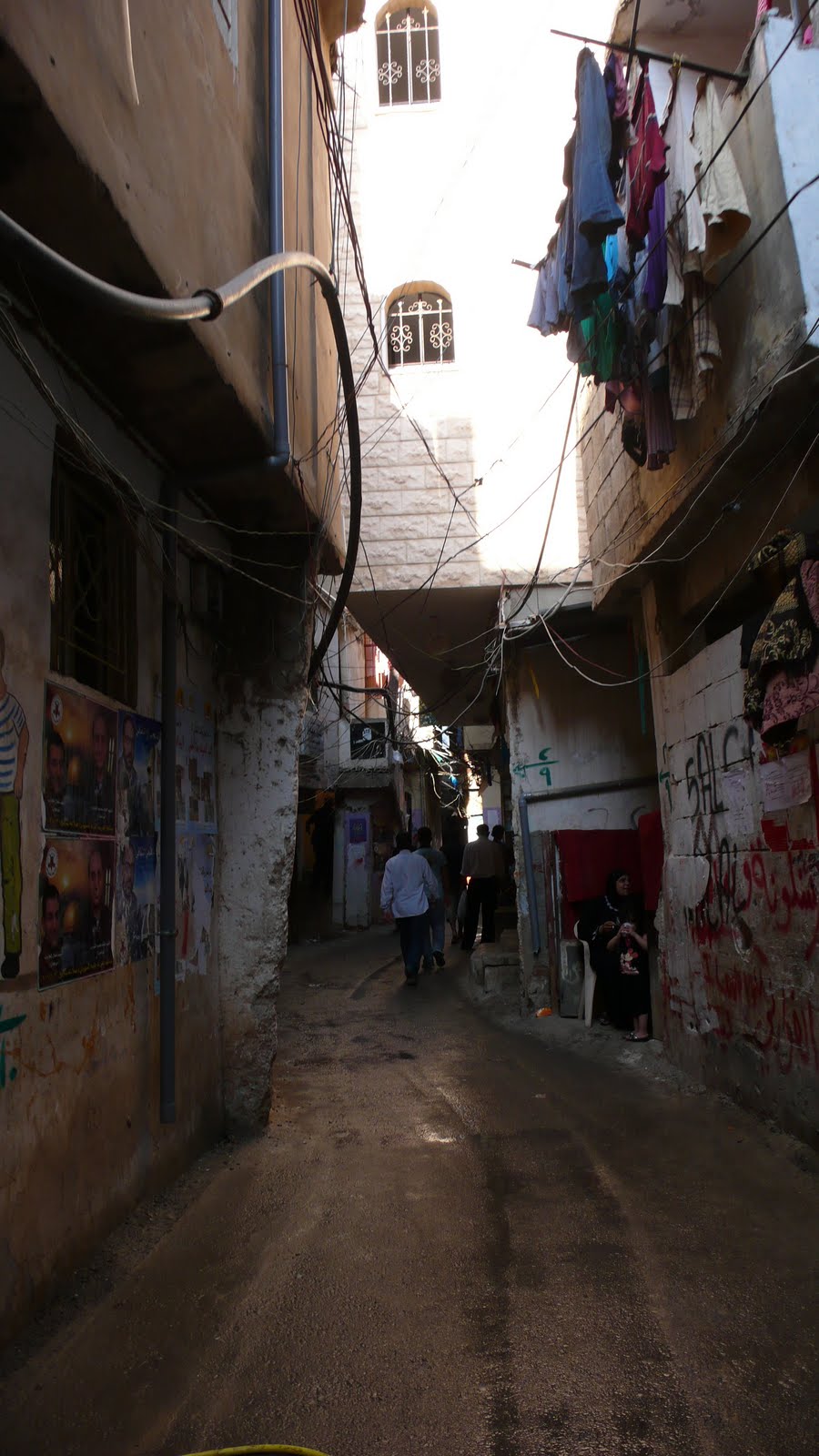
For years I've been looking forward to pay Beirut a visit, and I vowed I would not leave before I visited the Shatila camp. My friend provided us with a contact who was able to take us in the camp. I've had the opportunity to visit a number of refugee camps, but Shatila was one of the saddest ones I've been too. The electrical wires dangerously hang from the homes and destroyed buildings (such as the old PLO offices) are a constant reminder of the war.
Shatila camp
The mass graves of the victims of the 1982 Sabra and Shatila massacre (only photo I could get)

At night, we head to rue Solidaire and watch Spain beat Germany to clinch a spot in the World Cup finals and realize, we'll be in Spain for that game.

The next day we jump into a cab with a driver we met the night before. He offered to accommodate our brief schedule and take us to Jeita, Jbeil (Byblos) and Harissa for $150USD, after bargaining. Our first stop is the Jeita grotto, the magnificent crystallized limestone caves. Photography was prohibited because it supposedly damages the caves, although the entire park is sponsored by Kodak. Ironic? The Arab world is filled with irony. And contradictions. If you're ever in Lebanon, Jeita is a must-see.
View from the top of Harissa
The second stop was Harissa, home to the enormous status of the virgin Mary on the very top of the mountain. The cold breeze was a nice change to the humidity that filled the Beirut air. It's crazy how much Harissa resembles Haifa, and the journey to the top of the mountain via téléphérique only brought back memories of climbing Haifa's many stairs during shabbatt.

Byblos

Our third and final stop was in Byblos, a city I've wanted to visit for a long time. I felt like I was teleported back to the old city of Akka as the two looked very much alike. After eating fish and buying a few old postcards (exactly as I did in Akka), we returned to Beirut.
Byblos

I am an energetic person, be it on vacation or during regular days of life. I attempt to cover as much as possible in the short periods of time I have. My brief stay in Lebanon could not be fulfilled without a stop to the ocean where we found ourselves the only women sans boob jobs or nose jobs. I almost wanted to buy those Vicks strips to put on top of my nose and pretend I had one (kidding!). After gaining a few more freckles, I squeezed in a visit to one of Beirut's many bookshops where I had to remember that I was only allocated 23kg.